

As an Amazon Associate, we earn from qualifying purchases. Our opinions and recommendations are based on our own research and experience. We strive to provide accurate information; however, we cannot guarantee product availability, pricing, or specifications, as these may change without notice. If you purchase products through links on our website, we may receive an affiliate commission at no additional cost to you.
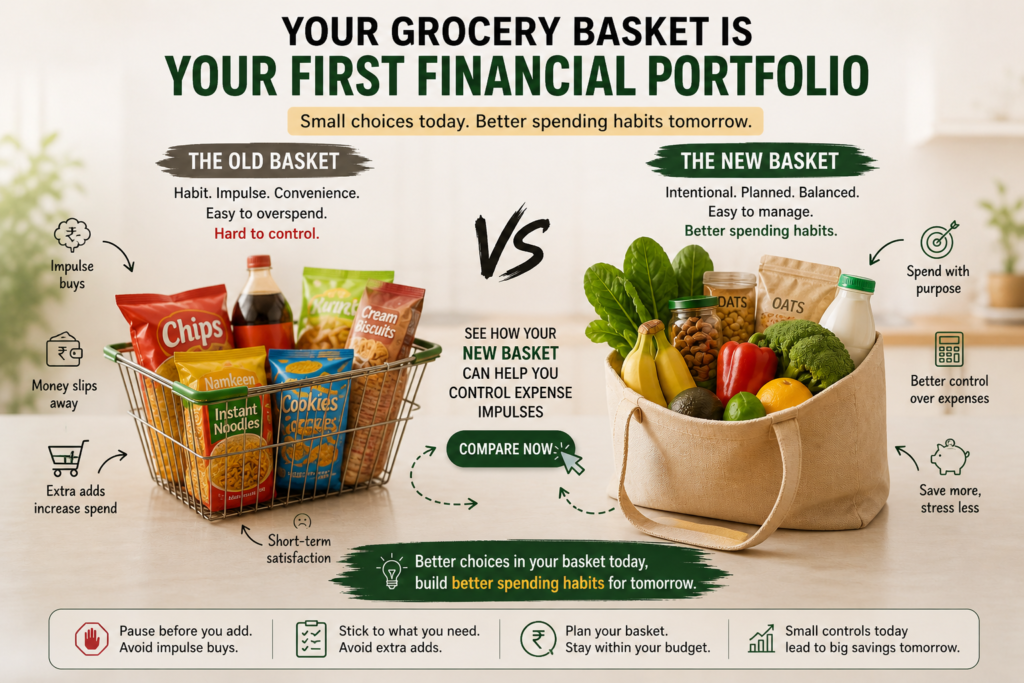
Start with your grocery basket—where your real spending habits live
The Easiest Way to Understand Your Money
Start with your grocery basket—where your real spending habits live
When people think about understanding their money, they imagine:
- Budget sheets
- Expense trackers
- Financial apps
But most of us don’t stick to those for long.
Not because they don’t work—
but because they don’t connect with how we actually live.
So here’s a simpler starting point:
Look at your grocery basket.
Because that’s where your real financial habits show up—every single week.
You’re already managing money (just not consciously)
Every time you shop for groceries, you:
- Decide what’s essential
- Add things you enjoy
- Make quick trade-offs
You don’t call it budgeting.
But that’s exactly what it is.
A pattern of decisions that repeats over time.
And that pattern quietly defines:
- How you spend
- What you prioritize
- How much you save
The unnoticed pattern in your basket
Think about your last order.
You added:
- The usual items you always buy
- A few things you felt like getting
- Maybe a couple of extras you didn’t plan
Nothing unusual.
That’s how most people shop.
But here’s what’s interesting:
This “normal” pattern is your financial behavior in action.
A simple way to see it clearly
Your grocery basket usually has three layers:
1. Essentials
Things you always need—your base.
2. Lifestyle
Things you enjoy—your flexible spend.
3. Health
Things that add long-term value.
Most people don’t consciously balance these.
They just repeat what feels familiar.
Why this matters
Because understanding money is not about restriction.
It’s about:
awareness + small adjustments
For example:
- Choosing something out of habit vs intention
- Adding something because it’s there vs because it adds value
These seem like small decisions.
But repeated over weeks and months,
they become your financial reality.
Where money quietly slips away
Not in big purchases.
But in everyday patterns:
- Adding items without thinking
- Buying more than you use
- Sticking to defaults without questioning them
Individually, they don’t feel important.
Together, they shape your spending habits.
Try this once (your first step)
Open your last grocery order.
Don’t change anything. Just observe.
Ask yourself:
- What did I really need?
- What did I add out of habit?
- What actually adds value over time?
This is the simplest way to understand your money:
see where it’s going
A better question to ask
Instead of:
“How do I reduce my spending?”
Try:
“How do I make this same spending work better?”
Because you don’t need to:
- Cut everything
- Change your lifestyle completely
You just need to:
be slightly more intentional
The idea of a smarter basket
What if your grocery basket stayed just as easy…
but became a little more balanced?
Not restrictive.
Not complicated.
Just clearer.
A basket where:
- Essentials are covered
- Lifestyle stays enjoyable
- Health is included consciously
A simple comparison
Take your current basket—the way you usually shop.
Now imagine a version of the same basket that is:
- Slightly more balanced
- Slightly more intentional
- Better aligned with long-term value
No drastic changes.
No extra effort.
Just a smarter version of what you already do.
Curious what that looks like?
See how your normal Rs 240 current basket compares with the new basket of approximately the same amount Rs. 240
What you’ll notice
Most people discover:
- A few items they don’t really need
- A few small changes that improve value
- A more balanced mix—without increasing spend
And that’s the key insight:
Understanding money isn’t complicated.
It just starts with awareness.
Why this goes beyond groceries
Because this isn’t really about food.
It’s about:
- How you make decisions
- How you evaluate value
- How you build habits
Once you see it here,
you start seeing it everywhere:
- Online shopping
- Subscriptions
- Everyday spending
Final thought
You don’t need spreadsheets to understand your money.
You don’t need complex tools.
You just need to notice what you’re already doing.
And sometimes, the simplest place to begin…
is your grocery basket.
Because the easiest way to understand your money…
is to start where you already spend it.
