
Direct ETFs vs. Index Funds (ETF FoFs): Which Route Should You Choose?
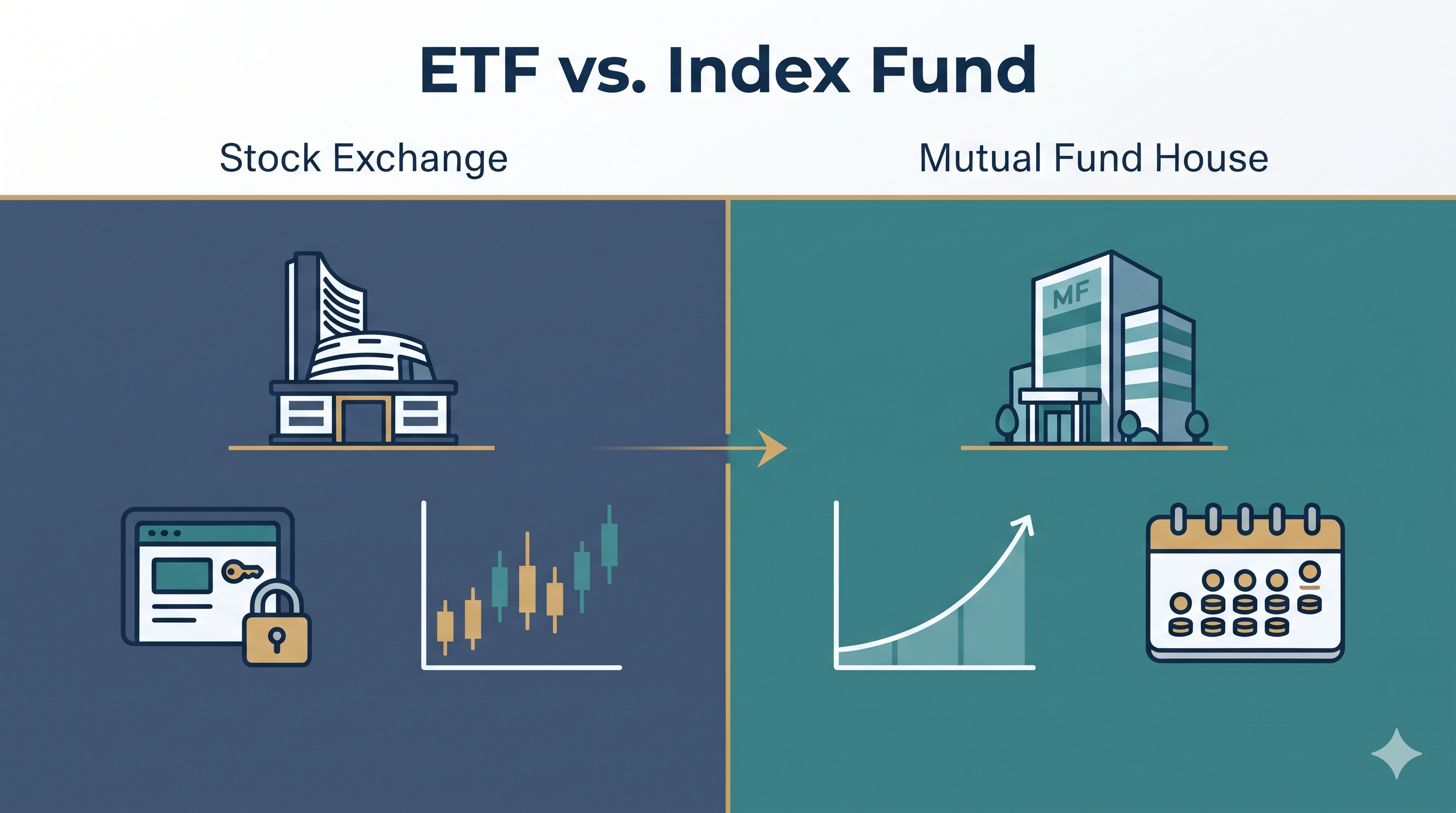
Both Exchange Traded Funds (ETFs) and Index Funds (including ETF Fund of Funds / FoFs) are designed to track the same underlying market index—such as the Nifty 50 or Sensex. Because they follow the same benchmark, their gross portfolio performance moves closely in tandem.
However, how you buy, hold, and manage them makes a meaningful difference to your day-to-day investing experience, costs, and convenience.
Side-by-Side Comparison
| Feature | Direct ETF (via Stock Exchange) | Index Fund / ETF FoF (via Mutual Fund House) |
|---|---|---|
| Account Required | Demat + Trading account is mandatory. | No Demat account required; can be invested in directly via AMC portals, RTA platforms, or mutual fund apps. |
| Pricing & Execution | Trades at real-time market prices during exchange hours, fluctuating continuously. | Priced at the end-of-day NAV (Net Asset Value) declared after market close. |
| Automated SIPs | Standard auto-debit SIPs can be less seamless because prices fluctuate intraday; often requires manual orders or stock SIP setups for whole units. | Supports smooth automated SIPs for fixed rupee amounts (for example, ₹5,000 a month), with fractional units allotted automatically. |
| Liquidity & Slippage | Depends on exchange trading volume; low-volume ETFs can have wider bid-ask spreads, leading to slippage when buying or selling. | Direct liquidity from the fund house at end-of-day NAV without relying on exchange order-book depth or bid-ask spreads. |
| Costs & Charges | Typically features a lower expense ratio, plus brokerage, statutory charges like STT, exchange fees, and Demat account charges. | Slightly higher expense ratio (and in an ETF FoF, layered costs across the FoF and underlying ETF), with no brokerage or Demat account fees. |
| Dividend Handling | Dividends are paid out to your bank account (taxed as per applicable slab) and must be reinvested manually. | Under the Growth option, dividends remain inside the scheme and compound automatically until redemption. |
When a Direct ETF on the Stock Exchange Makes Sense
Buying an ETF directly on the exchange can be a strong fit if:
- You already maintain a Demat and trading account and are comfortable placing exchange orders.
- You prefer intraday execution or want to place limit orders during market hours.
- You are investing in a liquid, high-volume ETF where the bid-ask spread is tight and transaction friction is low.
When an Index Fund or ETF FoF Through a Mutual Fund House Fits Better
Investing through a mutual fund scheme may be more practical if:
- You want a simple, automated monthly SIP for fixed rupee amounts without managing market-hour trades.
- You do not want to maintain a Demat account or pay separate brokerage and Demat fees.
- You prefer hands-off compounding through a Growth option without manually reinvesting small payouts.
Key Takeaway
Choosing between a Direct ETF and an Index Fund / ETF FoF isn't about finding a "magical" return difference on the same index—it's about matching the execution mechanism, cost structure, and convenience to your investing habits, time horizon, and financial goals.
Want to bring structured financial wellness and awareness sessions to your organization? Request a session at www.wena.co.in.